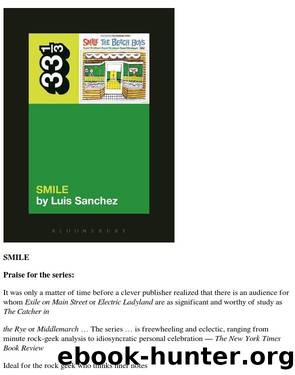
The Beach Boys' Smile by Sanchez Luis
Author:Sanchez, Luis
Language: eng
Format: epub
âWe Three Kingsâ a cappella, folding the showâs bustling pop pageantry into an atmosphere of ethereal wonder.
Itâs a jarring moment that directs itself inward, but in its passing, The Beach Boys prove that the conviction in this music doesnât come cheaply.
The day the Shindig! Christmas special aired was the same day that Brian experienced the emotional
⢠63 â¢
S M I L E
breakdown that led to the decision to remove himself
from touring altogether. Traveling with the rest of The Beach Boys on a flight from Los Angeles to Houston
to start a two-week U.S. tour, he realized he could no
longer write, produce, and perform to the same capacity.
He announced to the rest of the group several weeks
later that his role as a Beach Boy was best confined to the studio. It wasnât a retreat, but a realization that the groupâs best chance of advancing into new pop terrain,
terrain that would open up for something as bold as
Smile, meant that Brian had first to win both access and creative autonomy.
⢠64 â¢
To Catch a Wave
As of now, early 1973, it is clear that rock is neither the ultimate in cultural hallucinogens nor last yearâs
rush. It is an established, pervasive social force, and it is still growing. Note that I refer not to ârock and roll,â
the pop-happy big beat that was disdained by nearly
everyone except the kids who listened to it between 1955
and 1964, but to ârock,â a term that signifies something like âall music deriving primarily from the energy and
influence of the Beatlesâand maybe Bob Dylan, and
maybe you should stick pretensions in there someplace.â
Robert Christgau, âA Counter in Search of a Cultureâ
from Any Old Way You Chose It: Rock and Other Pop Music 1967â73
Rock Myth
âRockâ is a weird, loaded term. It has a capacity to evoke some combination of attitude, principles, ideas, and
maybe even a discrete kind of music. Rock may matter
as a kind of social common sense, a development that we can trace from the emergence of rock criticism in the
⢠65 â¢
S M I L E
mid-60s and the establishment of the flagship journal
Rolling Stone all the way to the present-day academic preoccupation with it (there are universities where you can earn a postgraduate degree in Beatle-ology). But
even in its ubiquity, its meaning still seems unsettled. Do people even make rock music anymore?
If there is such a thing as a baseline narrative to rock history, constructing it has been the work of journalists, critics, and fans who watched it unfold in front of them, not historians. Because of this, it often suffers from a generational perception of being blessed, a conviction
that if you came of age in the â60s your claim on the music is therefore more valid than if you made the mistake of being born too late. It is somewhat ironic, then, that rock legacy tends to be based on a glorified idea of what the music came to represent. There is a self-perpetuating
notion that drives a lot of rock history, which says that things had to happen the way
Download
This site does not store any files on its server. We only index and link to content provided by other sites. Please contact the content providers to delete copyright contents if any and email us, we'll remove relevant links or contents immediately.
Kathy Andrews Collection by Kathy Andrews(11967)
The remains of the day by Kazuo Ishiguro(9082)
Spare by Prince Harry The Duke of Sussex(5253)
Paper Towns by Green John(5247)
The Body: A Guide for Occupants by Bill Bryson(5175)
Industrial Automation from Scratch: A hands-on guide to using sensors, actuators, PLCs, HMIs, and SCADA to automate industrial processes by Olushola Akande(5086)
Machine Learning at Scale with H2O by Gregory Keys | David Whiting(4361)
Be in a Treehouse by Pete Nelson(4092)
Never by Ken Follett(4027)
Harry Potter and the Goblet Of Fire by J.K. Rowling(3911)
Goodbye Paradise(3857)
The Remains of the Day by Kazuo Ishiguro(3469)
Into Thin Air by Jon Krakauer(3451)
Fairy Tale by Stephen King(3448)
The Cellar by Natasha Preston(3387)
The Genius of Japanese Carpentry by Azby Brown(3344)
120 Days of Sodom by Marquis de Sade(3316)
Reminders of Him: A Novel by Colleen Hoover(3277)
Drawing Shortcuts: Developing Quick Drawing Skills Using Today's Technology by Leggitt Jim(3127)
